
Invasives Strike Force Protects Native Habitat along Trails
Partners & Affiliates
 Rutgers Dept. of Ecology, Evolution & Natural Resources
 New Jersey Invasive Species Strike Team (NJISST)

Partnership for Regional Invasive Species Management (PRISM) - Lower Hudson
Welcome to the NY-NJ Trail Conference Invasives Strike Force
a multi-organizational partnership in volunteer monitoring and controlling invasive plants along hiking trails
Menu
- ISF HOME
- The Invasive Issue
- Join the Project
- Where we Work
- Past Results
- Training Resources
- Volunteer Newsletters
- Questions? Contact Us!
- Resources
- Go Native!
The Trail Conference's Invasives Strike Force (ISF), started in 2011, is a project is born out of the ideas, learning and experiences of a joint project between the Trail Conference and Rutgers University from 2006-2009 that was supported by the USDA (US Dept. of Agriculture) to better understand the spread of invasive plants in forested parklands.
Project goals
- We need to collect information about what invasive plants exist and how abundant they are along all our trails.
- We will use this information to identify areas where removal of invasive species will allow us to prevent them from spreading into un-invaded communities.
- We will schedule trail crew work at these target locations and work to prevent and reverse the invasion along our trails.
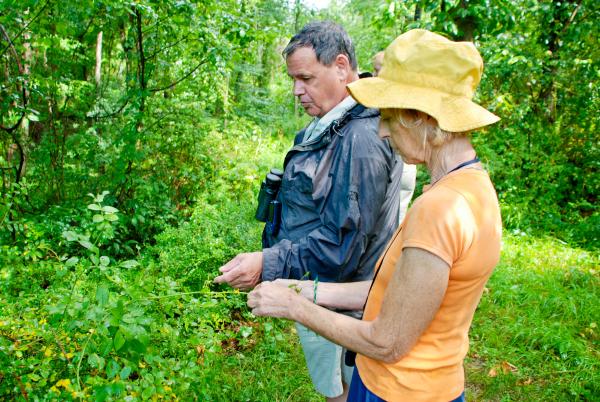
What do volunteers do?
We have two types of volunteers, surveying volunteers who survey trails for invasive plants and removal trail crew volunteers who work to remove invasives along the trails.
Surveying volunteers
As an Invasives Strike Force monitoring volunteer you will be required to attend one of several 1-day training classes to be held in late spring/early summer to learn how to identify 14 common invasive plants, how to collect data for the ISF and how to use a GPS. GPS units can be borrowed from the Trail Conference or you may use your own. After completing training, you will be assigned to a trail section (~2 miles long).
You will be expected to walk your trail section while identifying and mapping these invasive plants. This data collection can be completed within one outing or over several trips until you feel confident that you have identified all of the target species along your trail, but should be completed by the end of the summer.
After you have completed your trail section, you can ask to have another section assigned to you. You can map as many trail sections during the season as you have time for.
Or, you may prefer to learn the second set of invasive species and move on to Phase 2 mapping.
Removal volunteers
Removal volunteers are members of the Invasives Strike Force trail crew which holds removal workdays around the region. Volunteers learn on-the-job and anyone can participate.
Where can you work?
Check out the list of parks in New York and New Jersey that you can choose to help survey.
Seasonal Crew Positions
Our Invasives Strike Force volunteers are supported during the summer by our seasonal crew which helps train volunteers, leads removal work days and carries out additional removal projects with our park partners.
ISF News
2015 Goal: 1200 miles
Miles of Trail Surveyed
Since 2011
Trail Conference chosen by NY State to lead invasives partnership in the Lower Hudson Valley.
2012 Top Volunteer surveyors honored. Click here to read the story.
Acknowledgements
Thanks to the NJ DEP and the Easter Foundation for grant funding for the 2011 season, to the Zofnass family for contributions for the 2012-2013 season, and to Orange & Rockland Utlitiles for the 2013 season.
Thanks to the Flat Rock Brook Nature Center, the Pequest Trout Hatchery, Teatown Lake Reservation, the HEnRI Center and Westchester Land Trust for hosting training workshops.
Thanks also to the New Jersey Invasive Species Strike Team (NJISST) for providing interns to help with our surveying efforts in 2011.
And of course, thanks to all you volunteers!!